
This week openProd.io went live in the official Pimcore Store, listed under Pimcore Extensions as openProd.io AI Data Onboarding, available for Pimcore Enterprise and PaaS. The listing puts two layers of a product data stack side by side in one place: the platform that runs your PIM processes, and the layer that gets supplier data ready for it.
That pairing is worth slowing down on, because most teams treat it as one problem and budget for it as one. It is two, and they sit on opposite sides of a clear line.
Two disciplines, one line between them
A PIM is built to be the system of record and the process engine. It stores product data, governs it, versions it, enforces your model, and syndicates clean records out to every channel that needs them. Pimcore does this exceptionally well, which is exactly why it anchors thousands of enterprise catalogs. Once data is structured and trusted, the PIM is where it lives and works.
Getting data to structured and trusted is a different discipline entirely. Suppliers do not send model-ready data. They send PDFs with inconsistent units, 40-tab spreadsheets, XML in three competing schemas, scanned datasheets, and the same attribute under three names in two languages. Turning that into something the PIM will accept is upstream work, and it looks nothing like storing and governing records. It looks like extraction, interpretation, reconciliation and judgment under uncertainty.
That is the line. On one side, the PIM running your processes. On the other, the onboarding gap: everything that has to happen to raw supplier data before a PIM process can even begin. The two are complementary, not competing. A PIM is not failing when it cannot ingest a messy supplier PDF, any more than a warehouse is failing because it cannot drive the truck. Loading the truck is a different job.
Most PIM buyers meet that line the hard way, six weeks into an implementation, when the platform is configured and live and the project still stalls because nobody can get the supplier catalog into it.
What the onboarding gap actually costs
The gap is expensive precisely because it sits upstream, before the product ever reaches the PIM, where most budgets never look.
Across 70+ implementations at LemonMind, the pattern is consistent. Bringing 1,000 products to PIM-ready quality by hand runs about three months of work and roughly 14,000 EUR. That is not the license. That is not the integration. That is the human labor of turning what suppliers actually send into something the system, and increasingly an AI agent, can trust.
The enterprise reality makes it heavier. A typical B2B catalog at our ICP carries a classification store with 500 to 600 attributes per product. Suppliers populate a fraction of those, in their own formats, in their own languages, with their own units. The gap between “we received a product feed” and “we have a feed our PIM will accept without rework” is exactly that manual cleanup, and it scales linearly with SKU count unless you change how the data enters.
This is the cost the onboarding layer is built to remove. Not a PIM feature. A separate cost center that sits in front of the PIM and outside most project plans.
How openProd.io closes it
openProd.io is AI product data middleware: the layer between raw supplier data and a PIM-ready data model. The listing describes a tracked four-stage pipeline, parse, extract, map and apply, that does the upstream work the PIM is not built to do, then hands the result to Pimcore clean.
You upload a PDF catalog, Excel, CSV, XML or an image. A multi-agent system extracts structured data and rebuilds the full product structure, base products and variants, units of measure, relationships, not just flat fields. It reads your existing Pimcore model and maps each supplier attribute onto your attributes, proposing new attributes, groups and classification store keys only where the data genuinely needs them, so you do not end up maintaining a second parallel model alongside the one Pimcore already governs.
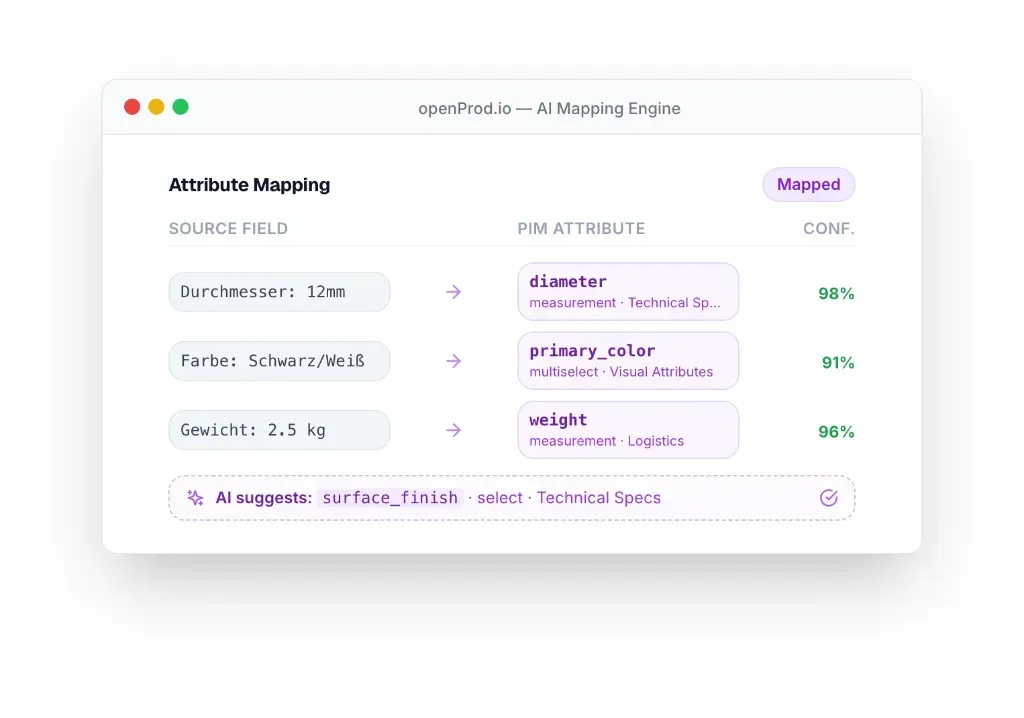
Two design choices matter more than the feature list. First, every field carries a confidence score from 0 to 100 percent. Green above 90 auto-approves, yellow gets a quick review, red gets a manual check. A human stays in the loop, but only where the machine is unsure, which is the difference between automating work and automating rework. Second, the export pushes clean, validated, pre-mapped data straight into Pimcore through the API, full catalog, a selection or a delta sync, with an audit trail on every change. openProd.io does the onboarding, Pimcore takes it from there and runs the process.
The number that anchors all of it: a supplier PDF to PIM-ready data in about 15 minutes on a live file, against roughly three months by hand for a thousand-product set. Up to 95 percent less time. That is a measured result from real files, not an estimate.
What changes now that the two layers sit together
The store listing is not just marketing. Putting the onboarding layer next to the platform changes the buying path in three concrete ways a CFO will recognize.
Procurement gets simpler. The onboarding layer is now a catalog item alongside the platform, with terms, a price and a subscription model, rather than a separate vendor conversation bolted onto the project mid-flight.
The cost moves out of the shadows. The manual onboarding spend that used to hide inside implementation services and internal headcount becomes a line item you can compare against the platform itself. The right question stops being “how much is the PIM” and becomes “what is our cost per 1,000 SKUs onboarded, and which side of the line are we still paying for by hand.”
And the risk profile changes. A confidence-scored, audit-trailed pipeline feeding the PIM is a different risk conversation than an undocumented spreadsheet process owned by whoever happens to know the supplier files this quarter.
None of this removes the work. It relocates it, from invisible internal labor into a measurable, governed layer that sits cleanly in front of Pimcore.
The stack is only as fast as its slowest layer
Every PIM, Pimcore included, promises a single source of truth, and delivers it once the data is in. The reason implementations stall is almost never the PIM running the process. It is the layer before it, the onboarding gap, still being worked by hand.
Pimcore runs that process as well as anyone. openProd.io exists to make sure the data reaches it clean, fast and at scale. Two layers, one job each, now in one stack.
So the question for anyone running Pimcore is not whether your platform is good. It is: how is supplier data reaching your PIM today, and what is that step costing you per 1,000 SKUs?
See it on your own files: book a demo at openprod.io.