On June 2, 2026, OpenAI moved product feed management into the ChatGPT Ads Manager. Retailers can now connect the same structured catalog they already send to Google Shopping, and ChatGPT builds sponsored product placements from it automatically. Up to one million SKUs per advertiser, a 100-product sample to start, ads served beneath answers on Free and Go plans. This follows the ad tests that began in the US on February 9, 2026, and a shopping surface that was already processing around 50 million shopping queries a day.
The e-commerce commentary since then has focused on the media questions. What will CPCs look like? How do you measure attribution inside a conversation? Should you shift budget from Google Shopping now or wait? Those are fair questions, and the people asking them are right to take the channel seriously. Q1 2026 numbers gave them good reason: AI-driven traffic to Shopify stores grew 8x year over year, and orders from AI-assisted sessions grew almost 13x.
But I think they’re being too polite about what OpenAI actually shipped. The most consequential line in the announcement is not the SKU cap or the pricing model, but this one: advertisers do not pick keywords or match types.
No keywords, no match types. The catalog is the campaign.
Read that again from a growth manager’s chair. For twenty years, paid search gave you a layer of craft between your product data and your ad: keywords, match types, ad copy, negatives. If the underlying catalog was mediocre, a good agency could still write its way to a decent Quality Score. The ad text was a human patch over machine-unreadable data.
ChatGPT’s product feed ads remove that layer entirely. The platform ingests your catalog, assembles ad units from product names, images, and attributes, and decides when to show them based on conversational intent. No copywriter sits in the loop. No keyword list compensates for a thin title or a missing attribute. The feed is not an input to the campaign. The feed is the campaign.
This is the same shift we described when Shopify turned the catalog into a protocol: machines are becoming the first reader of your product data. The ads version is simply more expensive to ignore, because now there is invoiced media spend attached to every gap.
Consider what conversational intent matching means in practice. A user asks ChatGPT for “a quiet dishwasher under 45 dB that fits a 45 cm kitchen niche.” The ad engine can only nominate products whose feed actually carries noise level, width, and installation type as structured attributes. If those values sit in a supplier PDF that nobody parsed, your dishwasher does not lose the auction. It never enters it. Zero impressions is not a bid problem. It is a data problem wearing a media costume.
AI doesn’t fix bad data. It amplifies it. In an ad channel, it amplifies it with your money.
What an attribute gap costs when the ad writes itself
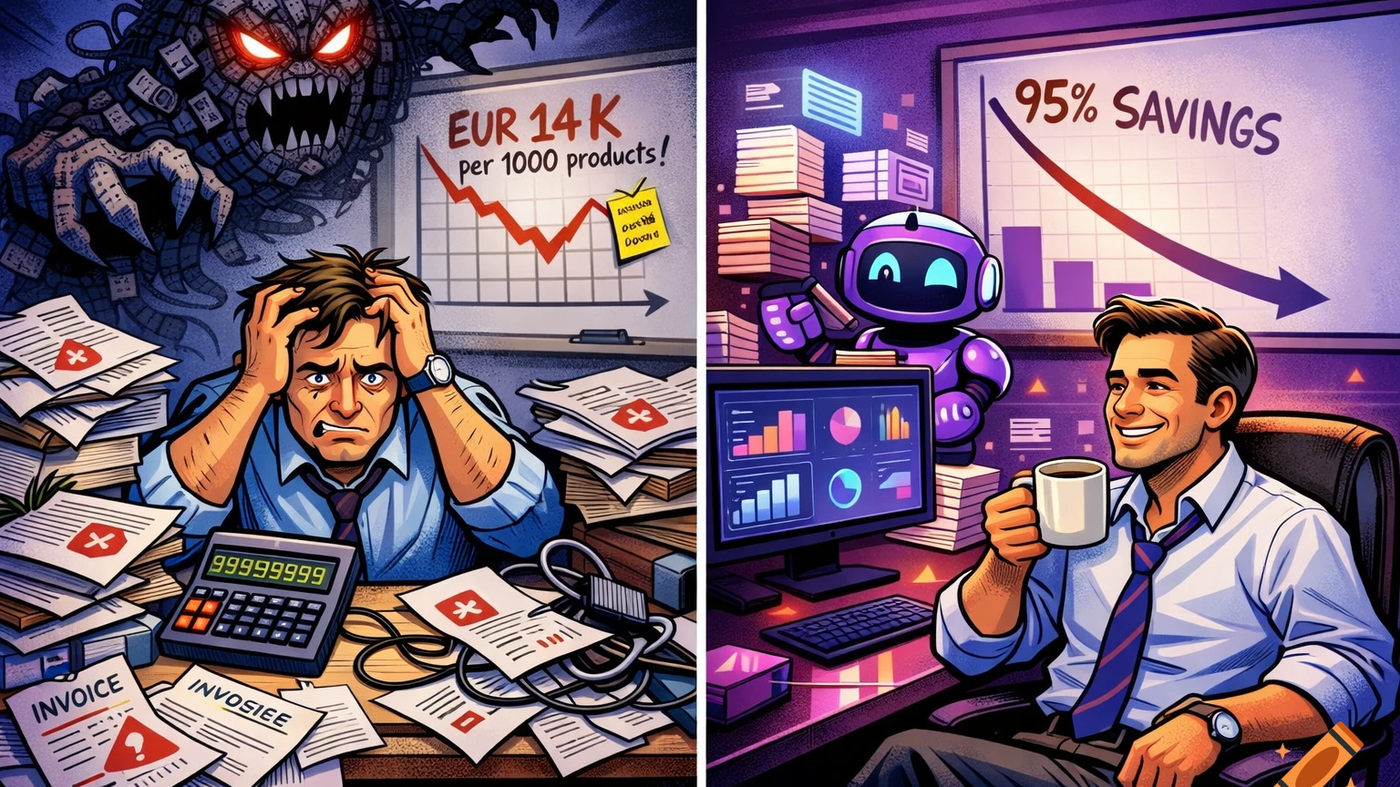
We have measured what it takes to close those gaps manually, across 70+ PIM implementations at LemonMind. Bringing 1,000 products to PIM-ready state by hand, meaning complete, consistent, machine-readable attributes, costs about EUR 14,000 and roughly three months of work. Not building the PIM. Just getting the data in.
That number was already uncomfortable when the payoff was operational: faster launches, fewer returns, cleaner syndication. Feed-based advertising changes the equation, because every unfilled attribute now has a second cost: it silently shrinks the share of your catalog that can be advertised at all.
Here is the arithmetic for a mid-size catalog:
| Catalog position | Products | What the ChatGPT ad engine sees | Commercial effect |
|---|---|---|---|
| Complete, structured attributes | 6,000 | Full ad units, matched to specific intents | Eligible inventory |
| Partial attributes (title and image only) | 3,000 | Generic ad units, weak intent match | Underperforming inventory |
| Attributes trapped in supplier PDFs and spreadsheets | 1,000 | Nothing to assemble | Invisible inventory |
Closing the gap for those 4,000 underperforming and invisible SKUs manually costs around EUR 56,000 at the measured rate, and close to a year of elapsed time. In a channel that moved from first ad test to full self-serve product feeds in under four months, a year of remediation is not a plan. It is a decision to sit the channel out.
The AI-native path compresses this to a different order of magnitude. In live sessions we take a raw supplier PDF to PIM-ready structured data in about 15 minutes, we have processed 4,000 products in roughly 90 seconds, and we have pulled 128 variants out of a single supplier document. The end-to-end time saving against manual onboarding runs up to 95%. The point of quoting these numbers is not the demo effect. The point is that “our feed is not ready for AI channels” has stopped being a fact of life and become a choice.
If you want to know which side of the table your own catalog sits on, a 15-minute supplier data audit will tell you before any ad budget does.
Ad budgets now inherit your data debt
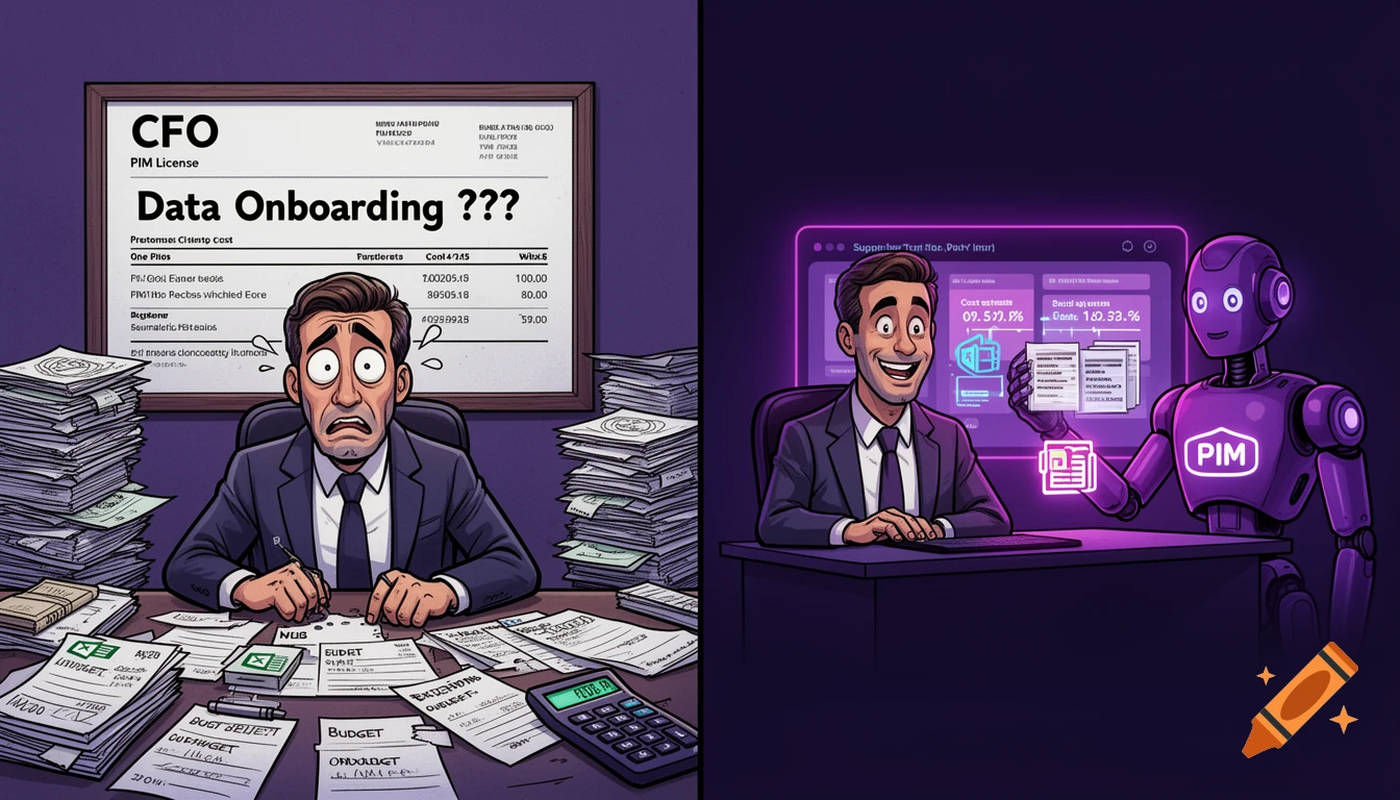
For the CFO, the mechanism to understand is this: media efficiency in feed-based AI channels is a function of data completeness, and data completeness is a function of your supplier onboarding process. That chain used to be invisible because humans padded every joint in it. Copywriters padded the gap between data and ads. Merchandisers padded the gap between supplier files and the catalog. In an automated feed channel, the padding is gone and the joints carry load directly.
This has three budget consequences worth writing down.
First, wasted spend moves upstream. In keyword advertising, waste showed up as clicks on bad queries, and you fixed it in the ads account. In feed advertising, waste shows up as strong products that never surface, and no amount of work inside the Ads Manager fixes it, because the defect lives in the feed. The budget for fixing waste belongs in data operations now, not only in media.
Second, the completeness metric that matters is not the one your PIM reports. Most systems will happily report 95% completeness, and agents will still disagree, a gap we unpacked in Your PIM Says 95% Complete. AI Agents Disagree. An attribute that exists but holds “see datasheet” is complete for a dashboard and worthless for an ad engine that needs a decibel value.
Third, the same feed now serves organic and paid machine surfaces at once. The catalog you connect to ChatGPT Ads is structurally the catalog that AI assistants read for organic recommendations, that Google’s shopping surfaces consume, and that agentic checkout protocols will transact against. Fixing the feed is not a single-channel cost but infrastructure, with returns across every machine-mediated surface, which is exactly how it should be presented in a budget review.
A useful way to frame the investment: at EUR 14,000 per 1,000 SKUs, manual remediation of a 10,000 SKU catalog costs about EUR 140,000 before you spend the first euro on media. An AI-native onboarding layer does the same work for a small fraction of that, in days instead of quarters, and keeps doing it for every new supplier file that arrives. One is a one-off project with a shelf life. The other is capacity.
The channel will judge your catalog either way
None of this is an argument against advertising in ChatGPT. The early numbers suggest the intent quality is real, and a channel where the user describes their problem in full sentences is a gift to any product with genuinely differentiated attributes. It rewards exactly the products that generic shopping ads flatten.
The argument is about sequencing. Connect a feed full of gaps to an engine that builds ads from attributes and you do not get a presence in conversational commerce. You get a precise, invoiced measurement of your data debt.
So before the first campaign brief, ask the operational question: how long does it take, today, to turn a new supplier’s files into complete, structured, feed-ready products? If the honest answer is weeks, that number is now part of your advertising economics.
Are you buying media, or are you paying to have your data gaps audited by an ad server?
If you would rather know the answer before the invoice arrives, book a demo and run openProd on your own supplier files. Fifteen minutes per file is usually enough to see what your feed has been leaving on the table.