For most of 2025 the story everyone told about agentic commerce was checkout. Buy inside the chat. Let the agent hold the card, place the order, close the loop without the shopper ever touching a website. Then the model met the data. In the second week of March 2026, reporting confirmed that OpenAI was scaling back its in-chat shopping plans, and the numbers behind the retreat were blunt: Walmart measured checkout inside ChatGPT converting roughly three times worse than a click-through to walmart.com, even though the same channel drove about twice the rate of new customers. The industry has since settled on a more durable pattern, and it is worth saying plainly because it changes what you should be spending on: discover in AI, buy on your own site.
They’re right. The in-chat wallet was the wrong hill to die on, and the people who called it early deserve credit.
But they’re being too polite about what moves next
The retreat coverage keeps underplaying one thing. When the purchase moves back to your own site, the discovery step does not move with it. It stays inside the AI. And that means the assistant, not your product page, is now the thing that decides whether you show up at all. The checkout UX you were about to rebuild is no longer the battleground. The battleground is the moment an agent reads a question, scans the available catalogs, and picks which products are eligible to be mentioned.
That moment runs entirely on structured attributes. Not copy, not photography, not the polish of your PDP. When an agent evaluates whether your product answers “a quiet 40 dB dishwasher under 600 euro that fits a 60 cm cabinet,” it is matching against noise level, price, and dimensions as machine-readable fields. If those fields are missing, wrong, or trapped in a supplier PDF you never fully parsed, you are not ranked low. You are absent. The shopper never sees a gap, because from their side there was nothing to see.
So the retreat did not lower the stakes on data. It raised them. In-chat checkout was one funnel among several, and a weak one. Discovery is now the single funnel that feeds every other one, and it judges you on the exact thing most catalogs are worst at: complete, standardized, trustworthy supplier attributes.
What the discovery gate actually reads
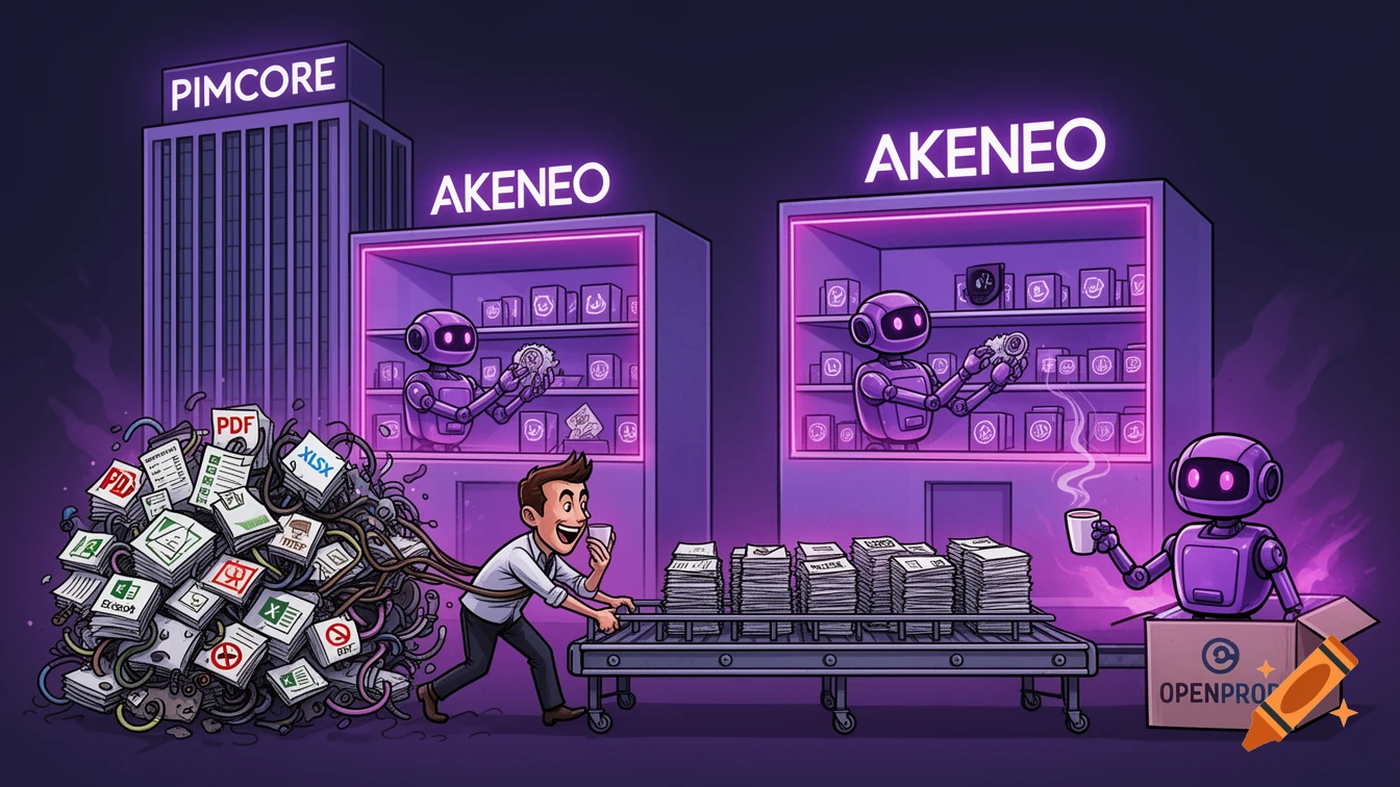
We have spent fifteen years and more than seventy PIM implementations watching where product data breaks, and it almost never breaks in the PIM. It breaks upstream, in the handoff from the supplier. The distributor’s own SKUs are usually clean. The 40,000 products they resell from 200 suppliers are the mess, and that mess is precisely the inventory an AI agent has to judge.
Consider the gap between what a PIM reports and what an agent needs. A PIM will happily tell you a record is 95 percent complete. An agent reading the same record disagrees, because “complete” in a PIM means the required fields are populated, while “usable” to an agent means the values are correct, consistent, and expressed in units it can compare. A field filled with “see datasheet” counts as complete. It is worthless at the discovery gate.
| What the shopper’s question needs | What the supplier file usually provides | What the agent does with it |
|---|---|---|
| Numeric noise level in dB | ”quiet operation” in a marketing blurb | Cannot match, product skipped |
| Dimensions as structured width, height, depth | one string “60x85x55” or a photo of the spec sheet | Cannot filter by cabinet fit, product skipped |
| Price as a comparable number | ”Call for pricing” or three conflicting values | Excluded from any budget-bounded query |
| Energy class as a controlled value | blank, or a scan of the label | Fails compliance and comparison filters |
None of this is exotic. It is the ordinary state of a catalog assembled from supplier spreadsheets, and it is the reason a PDF sitting in your inbox is not the same asset as a product an agent can surface.
The economics moved, and the CFO math moved with it
Manually bringing 1,000 products to PIM-ready quality runs about three months of work and roughly 14,000 euro. That number was already the largest hidden line in a PIM budget when the only cost of a missing attribute was internal inefficiency. Now the cost has a second half. Every attribute you never structured is an impression you never win in AI discovery, on inventory a competitor with cleaner supplier data does win.
That reframes the spend. You are no longer paying to make onboarding faster for your own team. You are paying for eligibility, the right of each SKU to be considered when an agent answers a buying question. The unit that matters is cost per 1,000 SKUs made discoverable, and the honest version of that calculation includes the products you currently cannot afford to onboard at all, which is where most catalogs quietly leave revenue on the table.
The good news is that the same math that made manual onboarding painful is what AI-native onboarding turns around. Extraction and structuring that took three months per thousand products collapses when the parsing is product-aware rather than generic. On live supplier files we see a PDF reach PIM-ready structure in about fifteen minutes, 4,000 products processed in roughly a minute and a half, up to 95 percent of the manual time removed. The point is not the speed for its own sake. The point is that discovery eligibility across a long tail of supplier products stops being a budget you cannot approve and becomes a run rate you can.
The question to ask before you rebuild anything
The reflex after the checkout retreat is to redesign the buying experience on your own site. Do that, but understand it is the second problem. If the agent never surfaces your product, the cleanest checkout in your category never gets tested. Before you touch the funnel you own, look at the funnel you no longer control and ask the only question that decides whether you appear in it: is your catalog ready to be judged by machines, on the supplier data you have right now?
If the answer involves a folder of PDFs you have been meaning to parse, that folder is your discovery gap, and it is measurable this week. Bring a real supplier file to a demo and watch how much of it becomes structured, comparable, agent-readable data in one sitting. That is the number worth knowing before the next planning cycle, because discovery is not coming. It is already the whole game.
Related reading: Your Product Feed Is Now Ad Inventory, Shopify Turned the Catalog Into a Protocol, Your PIM Says 95% Complete. AI Agents Disagree., Your Agents Are About to Start Writing Product Data. Who Signs Off?
Reminder for publisher: image field explicit in payload (fallback returns 404).