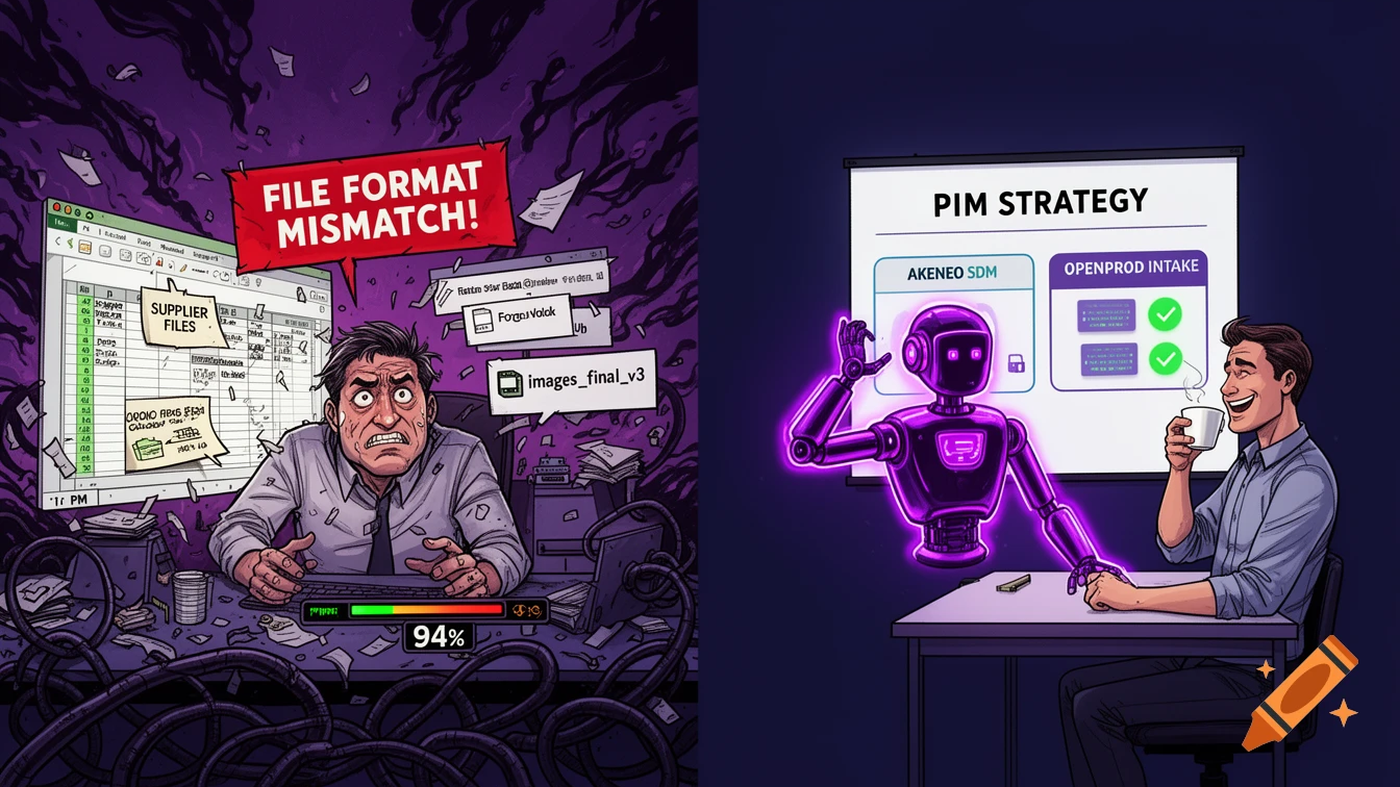
Ask a PIM vendor what manual product onboarding costs, and you’ll hear “it depends” or “contact our sales team for a quote.” Ask us-after implementing 70+ PIM systems for enterprise clients across Europe-and we’ll give you a number: €14,000 per 1,000 products. That’s the average cost of manual data entry. Not the PIM license. Not hosting. Labor. Here’s how we calculated that, why almost no one tracks it, and what changes when AI enters the equation.
The Hidden Cost No One Tracks
PIM vendors focus on license fees, implementation costs, hosting infrastructure. Manual data entry? That’s the invisible line item buried in “operational overhead.” Companies track software costs religiously-every renewal, every user seat, every gigabyte of storage. Labor costs for onboarding? Those disappear into general overhead.
It’s not that companies are careless. It’s that PIM onboarding looks like “part of someone’s job,” not a discrete cost center. One data manager enters products while also managing quality checks, exports, and vendor coordination. The hours disappear. Finance teams see PIM as an “IT investment,” not an ongoing operational cost that compounds with every new product line, every seasonal collection, every supplier relationship.
We’ve seen this pattern repeatedly. A €200M European manufacturer onboarded three product lines over nine months. They tracked the Pimcore license (€24K/year), the implementation partner fees (€80K), the hosting costs (€6K/year). When we audited their actual onboarding process, the labor cost came to €42,000-nearly half their entire PIM budget-and they’d never calculated it once.
In a survey of 30 LemonMind PIM clients, 68% couldn’t estimate their cost-per-product for onboarding. They knew what they paid for software. They had no idea what they paid for the human work of getting data into that software.
Breaking Down the €14,000
Let’s do the math that most companies skip.
Time per product: 20-30 minutes. That’s reading a supplier’s PDF spec sheet or Excel file with merged cells, mapping attributes to PIM fields, uploading product images, validating required fields, and saving. Simple products-a single SKU with 10 attributes-might take 15 minutes. Complex products-a configurable item with variants, technical specs, compliance data, and multi-language descriptions-can take 45 minutes. The median we’ve measured across client projects: 25 minutes.
1,000 products: 417 hours of pure data entry time. That assumes no breaks, no context switching, no meetings, no other responsibilities. In practice, add 20% for real-world conditions: 500 hours total.
Labor cost: A mid-level data manager in Europe earns roughly €30 per hour fully loaded (salary plus benefits plus overhead). That’s not a senior position-it’s the person actually doing the data entry work.
Base cost: 500 hours × €30 = €15,000.
But we’re not done. Manual entry isn’t just slow-it’s error-prone.
QA rework: In our client audits, 15-20% of manually entered products have at least one error. Wrong units (mm vs cm vs inches, especially German suppliers shipping to UK markets). Missing required attributes (GPSR compliance alone requires 15+ new fields by June 2026). Inconsistent naming conventions (“color” vs “colour” vs “clr” breaking website filters). Broken image links from filename typos. Copy-paste errors where the wrong spec ends up on the wrong product.
QA teams spend 30-40% of their time fixing manual entry mistakes. For 1,000 products with a 15% error rate, that’s 150 products requiring correction. At €30/hour and 15 minutes per fix, that’s another €1,125 minimum. Factor in the time to find the errors in the first place-QA reviews, customer complaints, marketplace rejections-and you’re adding €2,000-€4,000 to the total.
Our median: €14,000 per 1,000 products. The range? €12K-€18K depending on catalog complexity, data quality from suppliers, and how many languages or channels you’re managing.
Here’s a real example. A fashion wholesaler onboards seasonal collections: 1,200 SKUs per season, four seasons per year. That’s 4,800 products annually. At €14K per 1,000 products, they’re spending €67,000 per year on manual data entry labor. Their Pimcore license? €18,000 per year. They were spending nearly four times more on getting data into the PIM than on the PIM itself-and had no idea until we showed them the invoice breakdown.
The Errors That Cost More Than Time
Manual entry isn’t just slow. It’s unreliable in ways that cascade beyond the initial data entry cost.
A fashion brand we worked with launched 500 products with incorrect size charts-someone copied the wrong Excel column into the PIM during a late-night sprint before a collection launch. The error wasn’t caught until customers started receiving items. Returns, reprints of packaging, customer service hours, and lost trust: €85,000 in direct costs.
An electronics distributor missed CE compliance data on 200 products. Amazon pulled the listings. One month of lost sales while they scrambled to find documentation and re-upload: €12,000 in revenue, gone.
A building materials supplier entered wrong dimensions on a product line. Customers ordered based on website specs. Products arrived and didn’t fit. Manual corrections across three marketplaces, customer complaints handled individually, and reputational damage that’s harder to quantify: €8,000 in direct costs plus trust erosion with B2B buyers who have long memories.
These aren’t edge cases. They’re inevitable outcomes when you ask humans to read PDFs with poor formatting, interpret ambiguous specs, and manually type data for hours at a time. Errors aren’t a sign of incompetence-they’re a sign of cognitive load. Reading a German supplier’s merged-cell Excel file at 4 PM on a Friday is demanding work. Humans get tired. Attention drifts. Mistakes happen.
In LemonMind client audits, we consistently find that QA teams spend 30-40% of their time fixing manual entry errors. Every error costs €5-10 to remediate: find it, correct it, re-validate it, re-export it to channels. When 15-20% of your catalog has errors, that’s not a quality problem-it’s a process problem.
What Competitors Don’t Tell You
Go read Pimcore’s blog. Akeneo’s blog. Salsify’s resources section. You’ll find articles about “efficient workflows,” “onboarding best practices,” “data quality strategies.” What you won’t find: cost breakdowns. Time estimates. ROI calculations for manual labor.
There’s a reason for that. Manual onboarding is a feature, not a bug, for traditional PIM vendors. The longer you spend in their system doing manual work-training teams, building templates, refining import scripts-the more “sticky” the platform becomes. There’s no incentive to make onboarding 100x faster if it means customers could evaluate and switch PIMs more easily.
Pimcore’s “Import Wizard” still requires clean CSV files. If your supplier sends PDFs with tables as images, that’s your problem. Akeneo’s AI enrichment generates product descriptions and suggests tags-useful, but it doesn’t extract structured data from messy supplier files. Salsify assumes you already have structured data; their platform excels at syndication, not at solving the “I have 50 suppliers sending me data in 50 different formats” problem most manufacturers face.
And when these vendors do offer AI features-Pimcore plugins, Akeneo’s enrichment modules-the pricing is opaque. “Contact sales for enterprise pricing.” You don’t know what it costs until you’ve signed a contract and run your first extraction. Then you get the invoice.
We’ve had clients tell us they rejected competing AI tools because they ran a “test import” of 500 products and received a $200 surprise bill. No warning. No estimate. Just a charge. When you can’t predict cost, you can’t budget for it. And when you can’t budget for it, AI stays an “experiment” instead of becoming a budget line item.
How AI Changes the Math (But Not the Way You Think)
Let’s talk about what AI extraction actually costs-and what it doesn’t solve.
Cost: 1,000 products, using GPT-4o with vision (to handle PDFs, images, tables), processing roughly 1,000 tokens per product. Total API cost at current OpenAI pricing: €2.50. Not €2,500. Not €250. €2.50.
Time: Four hours to process 1,000 products through an extraction pipeline (assuming batching, API rate limits, and reasonable error handling). Compare that to three months of manual work.
Savings: €14,000 - €2.50 = 99.98% cost reduction.
Those numbers invite skepticism-understandably-so let’s address what AI extraction doesn’t solve and where human oversight remains essential.
AI isn’t perfect. Confidence scores for extracted fields typically range from 70-95%. High confidence means the AI is certain it found the right value in the source document. Low confidence means it’s guessing, or the source data was ambiguous. You still need human-in-the-loop review. In practice, 10-20% of products get flagged for human validation-someone needs to check that the extraction made sense.
So the realistic timeline isn’t “four hours and you’re done.” It’s “four hours of extraction plus one to two days of human review.” Still faster than three months. The realistic cost isn’t “€2.50 total.” It’s “€2.50 in API costs plus €500-€1,000 in human review time.” Still a 95% cost reduction.
The other thing AI doesn’t solve: garbage in, garbage out. If your supplier sends a PDF where the product specs are embedded in an image (not selectable text), AI will struggle. If your Excel file has merged cells and formulas that break when extracted, AI can’t magically infer structure. AI is extremely good at reading messy data that’s still fundamentally structured. It’s not magic.
But here’s what changes with AI: transparency.
When you use openProd.io’s AI extraction pipeline, you see the cost estimate before you run the extraction. Token count estimate, dollar amount, confidence score prediction. You decide whether the ROI makes sense before committing. That’s the difference between an AI experiment and an AI budget line item.
We’ve had customers tell us that cost transparency was the deciding factor. One customer evaluated three AI onboarding tools. Two had opaque pricing. openProd.io showed them: “This batch will cost approximately €3-5 to process.” They ran it. It cost €3.80. They knew what to expect. That predictability let them budget for AI onboarding as a recurring operational cost-not a scary black-box expense they’d have to justify to finance every quarter.
The Real Question Isn’t “Can We Afford AI?”
In 2023, the question was: “Can we afford to experiment with AI for product onboarding?” The answer was “maybe,” and mostly for enterprise clients with large enough catalogs to justify the risk.
In 2026, the question is: “Can we afford NOT to use AI?” And if you onboard more than 500 products per year, the answer is no.
Here’s the break-even math. Manual cost: €14,000 per 1,000 products. AI cost: €2.50 API + €500 human review = €502.50 per 1,000 products. Savings: €13,497.50 per 1,000 products.
If you onboard 100 products per year, you save €1,350. AI pays for itself in the first batch. If you onboard 5,000 products per year, you save €67,487 annually. That’s a full-time data manager’s salary-or three contractors during peak season.
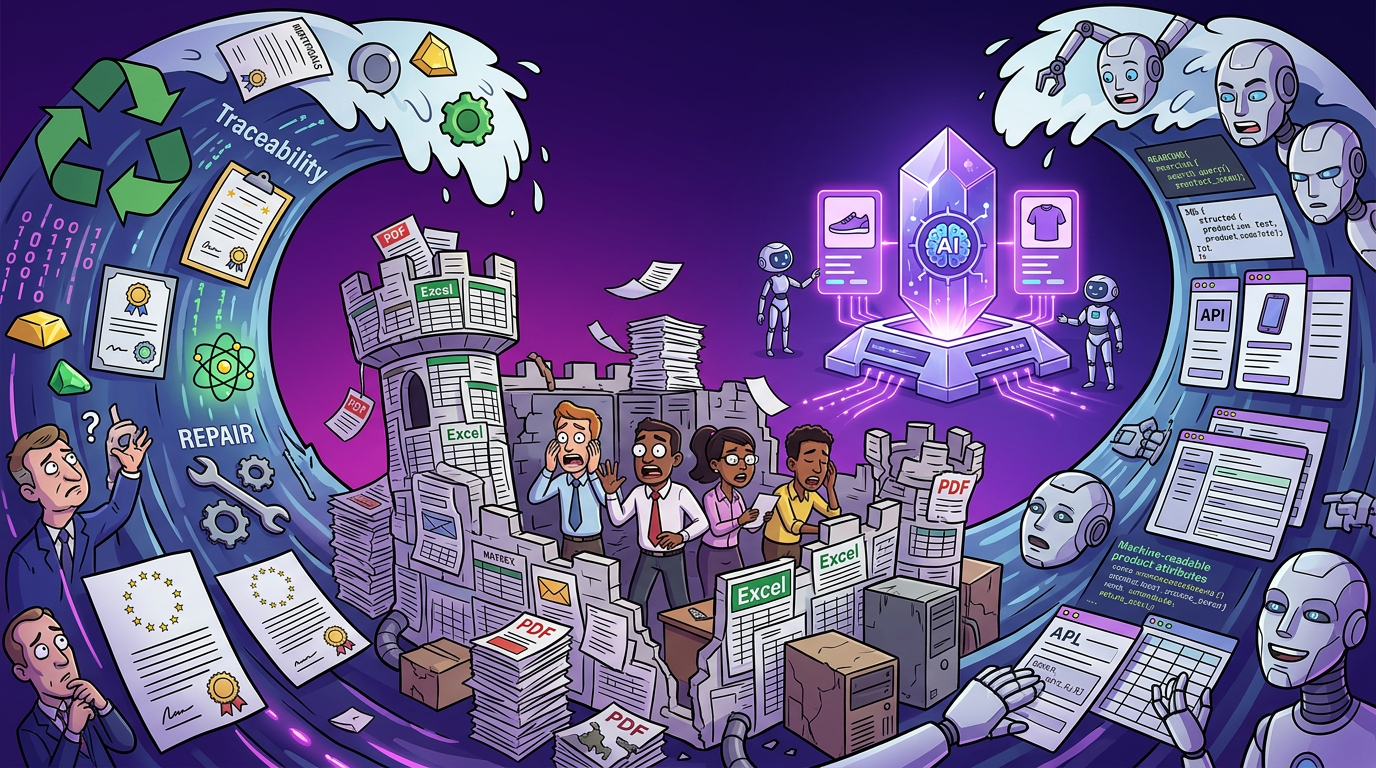
Now layer in context: the GPSR compliance deadline (June 2026) means companies are rushing to onboard compliance data for thousands of existing SKUs. E-commerce catalogs are growing 20-30% per year-more products, more SKUs, more variants. The labor market for skilled data managers is tight; salaries are rising. Multi-channel requirements mean the same product needs five different attribute sets (Amazon, Google Shopping, your site, a B2B portal, print catalogs).
Manual data entry was economically tolerable when catalogs had 500 SKUs and you onboarded once a year. At 5,000 SKUs with quarterly updates, GPSR compliance fields, and multi-channel syndication requirements, it’s untenable.
What to Do Tomorrow
If you’re responsible for product data at a company onboarding more than a few hundred SKUs per year, here’s a 15-minute exercise that will clarify whether AI onboarding makes sense for you:
Your Onboarding Cost Audit:
- How many products did you onboard last year? ______
- Average time per product (ask your team, or time 10 products and average it): ______ minutes
- Hourly labor rate (take a data manager’s salary, divide by 1,800 hours/year): €______
- Total cost = (products) × (minutes ÷ 60) × (hourly rate) = €______
If your number is above €5,000 per year, AI onboarding pays for itself in the first batch. If your number is above €20,000 per year, you’re leaving €18,000+ on the table annually by not adopting AI extraction.
Then ask your current PIM vendor or any AI tool you’re evaluating: “Can you show me a cost estimate before I run an extraction?” If the answer is anything other than “yes,” that’s a signal the vendor hasn’t solved the budgeting problem that keeps AI onboarding experimental rather than operational. Unpredictable costs mean unpredictable budgets, and unpredictable budgets mean AI stays a pilot project instead of becoming infrastructure.
For more guidance on building the business case for AI-powered PIM, read our deep dive on calculating the real ROI of a PIM implementation.
The Math Changed. Your Process Should Too.
The €14,000 isn’t a made-up number. It’s the median cost we’ve calculated across 70+ PIM implementations when clients finally audit their onboarding labor. Some spend less-smaller catalogs, simpler attribute structures, high-quality supplier data. Some spend far more-compliance-heavy industries, multi-language requirements, suppliers who send data as scanned PDFs from the 1990s.
Almost none of them tracked it before we asked.
AI didn’t just get cheaper in 2026. It became necessary. Catalogs are growing. Compliance requirements are increasing. Labor is expensive and hard to find. Manual data entry was a tolerable bottleneck when it was a one-time cost for a static catalog. When it’s a recurring cost for a dynamic, growing, multi-channel catalog, the economics don’t work anymore.
The question isn’t whether to adopt AI for product onboarding. It’s whether you’re already late.
Sources & Further Reading
- LemonMind Client Audits (2020-2026) - Internal data from 70+ PIM implementations across Europe (40M+ SKUs delivered)
- EU General Product Safety Regulation (GPSR) - Official EU compliance requirements (effective December 2024, full enforcement June 2026)
- OpenAI API Pricing - GPT-4o and GPT-4o with Vision API costs (current rates)
- Pimcore Documentation - Import Wizard capabilities and limitations
- Akeneo Product Documentation - AI enrichment features and PIM workflows
All cost calculations and labor estimates in this article are based on LemonMind’s 15 years of PIM implementation experience, including detailed time-tracking audits conducted with client teams during onboarding projects.