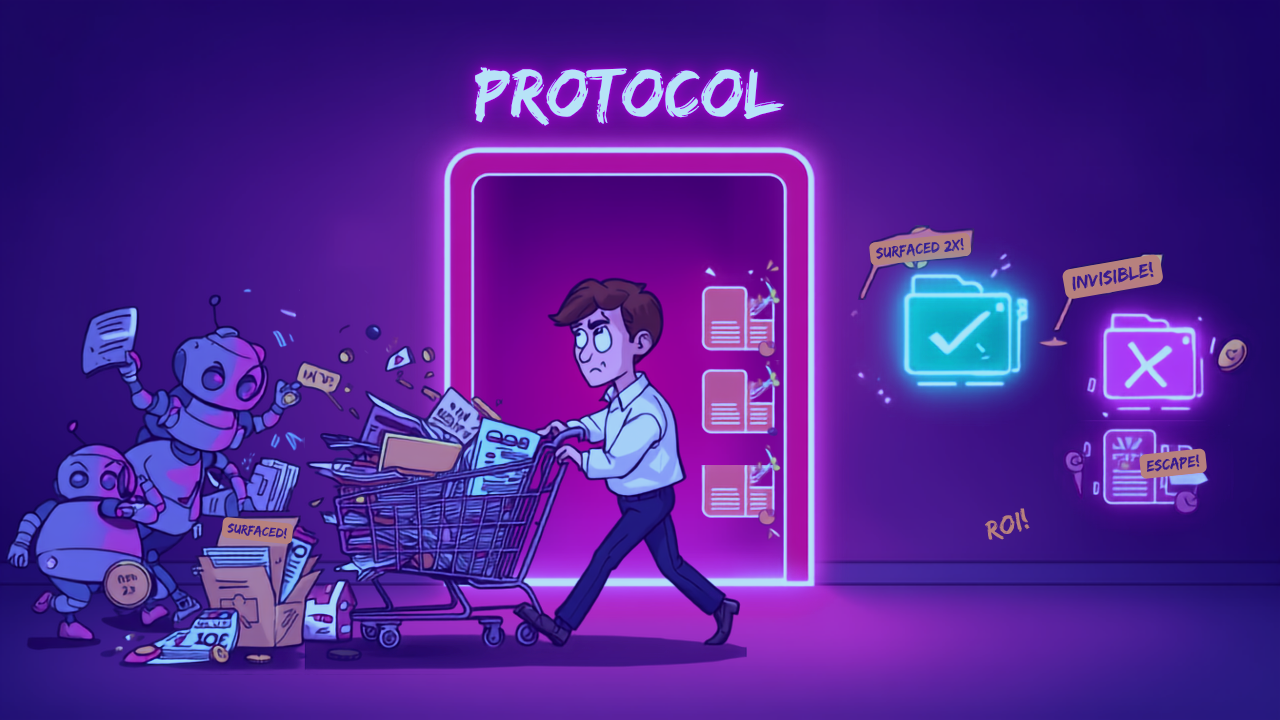
The EU Digital Product Passport starts enforcing mid-2026. AI shopping agents are already here. And 90% of your product data is still locked in spreadsheets and PDFs. If that doesn’t alarm your CFO, nothing will.
Here’s the uncomfortable truth I keep running into across 70+ PIM implementations: companies that spent years building product catalogs are about to discover their data is functionally useless — both for regulatory compliance and for the AI-driven commerce wave that’s already reshaping how B2B buyers find and evaluate suppliers.
The Digital Product Passport isn’t some distant EU bureaucracy exercise. The first delegated acts take effect mid-2026 for batteries and industrial equipment, with textiles, electronics, and furniture following by 2028-2029. Meanwhile, Gartner predicts 90% of B2B purchases will be AI agent-intermediated by 2028, routing $15 trillion in spend through automated exchanges.
Both trends demand the same thing: structured, machine-readable, continuously updated product data. And most enterprises don’t have it. Not even close.
The DPP Is Not Another Compliance Checkbox
Let me be blunt. Most companies I talk to treat the Digital Product Passport like GDPR circa 2017 — something to worry about “next quarter.” That’s a $1.80 billion market growing at 33% CAGR (The Business Research Company), and it’s growing because the enforcement mechanisms have real teeth.
Under the ESPR framework, each DPP must contain verifiable, interoperable data on materials, environmental footprint, repair instructions, hazardous substances, and full lifecycle traceability. The data must be machine-readable, follow open standards compatible with GS1 identifiers, and remain live — not static PDFs buried in a shared drive.
Here’s what the regulation actually requires for every product entering the EU market:
| Data Category | What’s Required | Where It Typically Lives Today |
|---|---|---|
| Product identification | Unique ID, model, manufacturer details | ERP (partially) |
| Material composition | Full Bill of Materials, SVHC substances | Supplier spreadsheets, email attachments |
| Environmental footprint | Carbon footprint, energy consumption | Nowhere, or annual CSR report |
| Durability and repair | Lifespan, spare part availability, repair manuals | PDF manuals, if they exist |
| End-of-life handling | Recycling instructions, disposal guidelines | Packaging text, maybe |
| Compliance certificates | Declarations of conformity, test reports | Filing cabinets, literally |
The real challenge, as Acquis Compliance notes, isn’t regulatory understanding — it’s data orchestration at scale. And if you’re still running supplier onboarding through email and Excel, the gap between where you are and where you need to be is measured in years, not sprints.
So here’s the question every Head of E-commerce should be asking: if you can’t structure your product data for a compliance requirement with a known deadline, how will you structure it for AI agents that won’t wait at all?
AI Agents Don’t Browse. They Query.
The second force reshaping product data requirements is agentic commerce. This isn’t theoretical anymore. Google launched agentic checkout across Search and Gemini with “Buy for me” functionality. Perplexity and OpenAI have built shopping experiences where AI agents discover, compare, and purchase products autonomously.
In B2B, the implications are even more dramatic. When a procurement agent asks “Find me an eco-friendly industrial adhesive under EUR 50 per liter, REACH-compliant, available within 5 days” — it’s not scrolling your website. It’s querying structured data feeds. If your product attributes aren’t in machine-readable fields with standardized values, your catalog is invisible to the fastest-growing sales channel in commerce.
Ben Adams from Nestlie’s Global Digital Shelf team put it simply: “In agentic commerce, your structured data becomes your storefront.” Not your website. Not your sales team. Your data.
What “agentic-ready” product data requires:
- Canonical schema per SKU: Explicit fields for every attribute an agent needs — material, dimensions, compliance ratings, GTIN, shipping class — populated with standardized, unambiguous values
- Single source of truth via API: Agents query authoritative endpoints, not scraped HTML. Your PIM must expose real-time, normalized records
- Live inventory and pricing: Not batch-updated CSVs from last Tuesday. Real-time accuracy at the moment the agent makes a purchase decision
This is precisely where the PIM onboarding bottleneck becomes a strategic crisis. If onboarding a single supplier’s catalog takes weeks of manual mapping and cleanup, you won’t have structured data for DPP compliance, let alone agentic commerce readiness. You’ll have a backlog.
The EUR 14K Problem Just Got Three Times Worse
We’ve written before about the true cost of manual product data entry: EUR 14,000 per 1,000 products. That calculation was based on standard PIM onboarding — mapping attributes, normalizing values, filling gaps, running QA.
Now add DPP requirements on top.
Every product needs sustainability metrics that don’t exist in your current data model. Every supplier must provide material composition in structured formats they’ve never been asked to deliver. Every compliance certificate needs to be digitized, linked, and kept current. The cost per product doesn’t just increase — it multiplies.
Estimated cost impact of DPP on product data operations:
| Scenario | Products | Manual Cost (PIM only) | Manual Cost (PIM + DPP) | With AI-Automated Onboarding |
|---|---|---|---|---|
| Mid-size retailer | 5,000 | EUR 70,000 | EUR 180,000 - 250,000 | EUR 12,000 - 18,000 |
| Enterprise manufacturer | 25,000 | EUR 350,000 | EUR 900,000 - 1,250,000 | EUR 55,000 - 80,000 |
| Multi-brand distributor | 100,000 | EUR 1,400,000 | EUR 3,500,000+ | EUR 200,000 - 300,000 |
These numbers aren’t hypothetical. They’re extrapolated from what we see across 70+ implementations: DPP data collection adds 2.5-3.5x overhead to every product when done manually, because the data sources are fragmented, the formats are inconsistent, and the update cycle is continuous rather than one-time.
The payback period for automating this with AI drops from months to weeks when you factor in DPP requirements. A CFO looking at a EUR 1.25 million manual data bill versus EUR 80,000 for automated onboarding doesn’t need a business case — they need a purchase order.
What’s the cost of not automating? It’s not just the labor. It’s market access. Under the Green Claims Directive, incomplete or fraudulent DPP data can trigger fines of up to 4% of annual turnover. That’s GDPR-level enforcement for product data.
Why Your Current PIM Won’t Save You
Here’s where I’ll be contrarian with my own industry. PIMs are necessary. They are not sufficient.
A PIM gives you a single source of truth for product attributes. Great. But DPP compliance requires data from PLM systems, ERP, supplier databases, sustainability platforms, and compliance management tools. As Inriver’s DPP analysis acknowledges, “PIM doesn’t operate in a vacuum. Achieving DPP success requires a well-tuned, connected ecosystem.”
And agentic commerce readiness? That requires your PIM data to be exposed through real-time APIs with canonical schemas — something most PIM implementations treat as an afterthought.
The missing layer is intelligent data onboarding: the ability to take messy, multi-format supplier data — spreadsheets, PDFs, specifications in 17 different layouts — and transform it into structured, validated, PIM-ready records. Automatically. At scale. With pre-run cost estimates so you know exactly what you’re spending before you commit.
This is what we built OpenProd to solve. Not to replace your PIM — Pimcore, Akeneo, Ergonode all do their job well. But to eliminate the bottleneck between raw supplier chaos and clean, structured, compliance-ready product data. Using AI that understands product data semantics, not generic document processing that treats a material safety data sheet the same as a restaurant menu.
The difference between generic AI and purpose-built product data AI is the difference between a translation app and a native speaker. One gives you words. The other gives you meaning.
The 90-Day Action Plan That Actually Works
Gartner predicts that through 2026, organizations will abandon 60% of AI projects due to insufficient data quality. The companies that succeed will be the ones who treat product data readiness as a strategic initiative, not an IT ticket.
Here’s a practical roadmap — tested across our implementations:
Days 1-30: Audit and baseline. Map every product attribute and the system that owns it. Identify what’s structured vs. what lives in PDFs and emails. Flag the gap between current data and DPP requirements for your product categories. This alone reveals the true scope of work — and usually shocks leadership into action.
Days 31-60: Automate the onboarding pipeline. Deploy AI-powered data onboarding for your highest-volume supplier category. Target 95% time savings on attribute mapping and normalization. Establish the canonical schema that serves both your PIM and future DPP requirements. This is where tools like OpenProd’s MCP Server create a step change — connecting AI capabilities directly to your PIM through standardized protocols instead of brittle custom integrations.
Days 61-90: Validate and scale. Run the pilot category through DPP readiness checks. Measure the gap closure. Build the CFO-ready business case with actual numbers from your pilot — not industry averages. Then scale to the next five categories.
The companies that start this quarter will be DPP-compliant and agentic-ready by mid-2026. The ones that wait will be hiring contractors at panic rates to manually fill spreadsheets while their competitors’ products are already being recommended by AI agents.
Which side of that divide do you want to be on?
Sources and Further Reading
- Acquis Compliance: Digital Product Passport (DPP) - EU ESPR Compliance
- Commercetools: 7 AI Trends Shaping Agentic Commerce in 2026
- The Business Research Company: Digital Product Passport Market Size 2026
- Bluestone PIM: Digital Product Passport in Retail
- Inriver: How to Prepare for Digital Product Passports
- Ben Adams / LinkedIn: Structured Product Data — The Foundation for Winning in Agentic AI
- Gartner via Activate Business School: 60% of AI Projects Will Fail Due to Data Quality
- ExploreTex: The Rise of the Digital Product Passport — A 2026 Guide
- Onix: EU Digital Product Passport — A Practical Guide