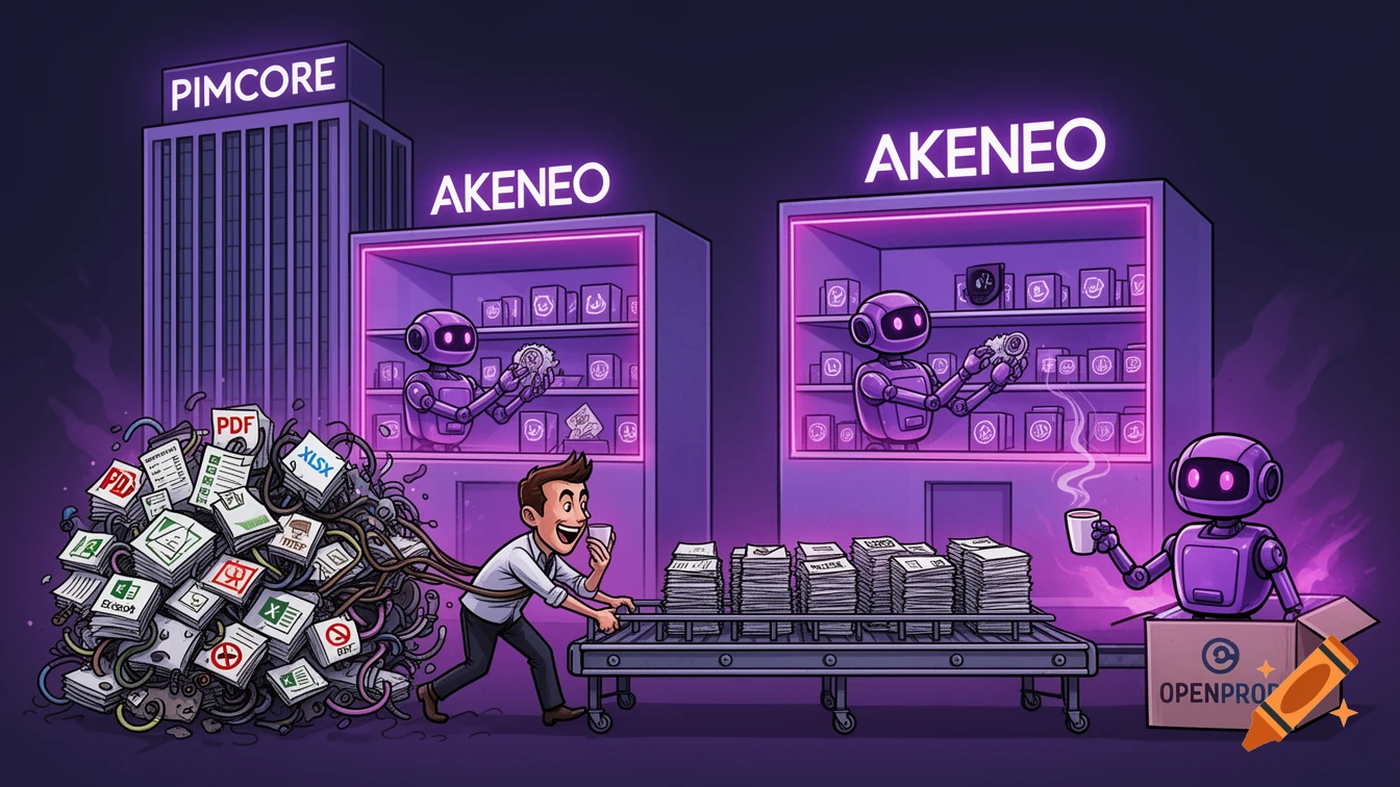
The Spring 2026 PIM Agentic Race: Who Actually Solves the Data Problem?
Pimcore launched Studio 1.0 today. Syndigo shipped Synapse two weeks ago. Sales Layer has an MCP Server. Inriver embedded GPT-5. Everyone wants you to believe they cracked “agentic PIM.”
Juniper Research just forecast $1.5 trillion in agentic commerce by 2030 - up from essentially pilot programs in 2026. That is a 43,240% growth projection. So the stampede makes sense. Every vendor knows that whoever owns the agentic layer owns the next decade of product data management.
But here is the problem nobody on stage at Pimcore Inspire, Shoptalk, or any vendor keynote will say out loud: agentic features on top of dirty data produce agentic garbage. Faster. At scale. With better UX.
I have watched this pattern across 70+ PIM implementations at LemonMind. A brand buys the shiny AI module, plugs it into a catalog where 40% of attributes are missing or inconsistent, and then wonders why the autonomous workflows keep failing quality gates. The bottleneck was never the agent. It was always the data going in.
So let me break down what each vendor actually shipped this spring, what it solves, and what it quietly assumes you already fixed.
What Did Pimcore Ship at Inspire 2026?
Pimcore’s Inspire 2026 conference in Salzburg (April 14) is a milestone event. The headline: Pimcore Studio 1.0, the first full-featured GA release of their redesigned interface. Over 19,000 hours of development. The Classic Admin UI gets deprecated entirely in Platform Version 2026.1 - Studio becomes the only way in.
Alongside Studio, Pimcore is pushing its “agentic AI direction” - what they call “PXM agents in action.” Details are still emerging from the event, but the positioning is clear: Pimcore wants to be the platform where AI agents operate natively on product data, digital assets, and experience management.
What it solves: Editor and admin workflows get a modern, extensible UI with an SDK for custom integrations. The agentic capabilities promise coordinated AI workflows across Pimcore’s data model.
What it assumes: Your data is already inside Pimcore and structured correctly. If you are migrating from spreadsheets, legacy systems, or onboarding supplier data for the first time - Studio 1.0 does not fix that intake problem. Pimcore’s agentic features operate on data that already lives in Pimcore. Getting it there clean? That is still your problem.
And here is the thing - Pimcore Platform 2026.1 removes the Classic UI entirely. So every Pimcore customer is now on a forced migration path to Studio. That is a significant operational lift that has nothing to do with AI and everything to do with interface transition. While your team is learning the new UI, who is fixing the EUR 14K per 1,000 products worth of manual data onboarding sitting in the backlog?
What Is Syndigo Synapse Actually Doing?
Syndigo launched Synapse at Shoptalk 2026 on March 24 - calling it “the industry’s first agentic PXM platform.” The pitch: coordinated AI agents that handle the entire product lifecycle from creation and onboarding to syndication and optimization, with human checkpoints at critical decision points.
Synapse is built on Syndigo’s multi-domain Master Data Management (MDM) foundation. Agents can reason across product, supplier, location, compliance, and performance data. They work in sequences or in parallel, passing work between steps automatically.
The specific promises:
- Accelerate product onboarding and reduce time to shelf
- Generate, adapt, and optimize content to improve conversion
- Reduce retailer rejections through automated validation
- Continuously improve data using downstream performance signals
What it solves: For brands and retailers already inside the Syndigo ecosystem (8 of the top 10 global retailers, 18,000+ enterprises), Synapse adds an orchestration layer that reduces manual intervention in established workflows.
What it assumes: You are already a Syndigo customer with data flowing through their Product Experience Cloud. The 1WorldSync acquisition extended their content network to 3,500+ retailers, but that is a distribution network - not a data onboarding solution. If your supplier sends you a 47-column Excel file with German attribute names and inconsistent units, Synapse is not the tool that cleans it up before ingestion.
The real question evaluators should ask: does Synapse reduce onboarding time from weeks to hours, or does it optimize what happens after onboarding is already done?
Where Does Sales Layer’s MCP Server Fit?
Sales Layer shipped an MCP Server that connects your PIM catalog to any MCP-compatible AI application - Claude, ChatGPT, or custom tools. Two deployment options: hosted (just add the server URL) or local installation. Read-only and read/write modes. Included with your PIM license at no extra charge.
What it solves: AI tools can query, analyze, and interact with your Sales Layer product data through a standardized interface. No custom API development required. You can run catalog audits, bulk updates, generate variants, and build approval workflows through MCP-connected applications.
What it assumes: Your data is already in Sales Layer. The MCP Server is a connectivity layer - arguably the best one any vendor has shipped so far in terms of simplicity and standards compliance. But it does not fix the upstream problem. If the data entering Sales Layer is incomplete, the MCP Server just gives AI applications faster access to incomplete data.
Look, Sales Layer deserves credit here. They are one of the few vendors that actually adopted MCP as a first-class integration standard rather than building yet another proprietary AI wrapper. But connecting AI to your PIM is step two. Step one is getting clean data into the PIM in the first place.
Inriver’s Strategy: Embedded AI Models
Inriver took a different path. Their Spring 2026 release embeds GPT-5-mini and GPT-5-nano directly into the platform - letting you balance response speed with reasoning depth by task. They also launched an MCP Server, Content Onboarding with AI field mapping, and Syndicate Advance for multi-channel distribution.
What it solves: Inriver’s Content Onboarding feature is actually closer to addressing the data intake problem than most competitors. It lets teams upload spreadsheets, auto-map fields with AI, apply transformation rules, and validate data before it enters the system.
What it assumes: The AI mapping works well for structured data that roughly fits Inriver’s data model. But “auto-map fields” is not the same as “understand that this German supplier’s ‘Artikelbreite’ column contains mixed units, some in centimeters and some in millimeters, and normalize them before import.” Domain-specific product data intelligence requires more than generic AI field matching.
The embedded GPT models are a smart move for content generation and enrichment. But again - the foundational question remains: what happens before the data hits the PIM?
The Comparison Matrix Nobody Wants to See
Here is what the competitive landscape actually looks like when you evaluate for the full data lifecycle, not just the features vendors put on stage:
| Capability | Pimcore Studio | Syndigo Synapse | Sales Layer MCP | Inriver Spring ‘26 | OpenProd.io |
|---|---|---|---|---|---|
| Agentic workflows on existing data | Yes (new) | Yes (new) | Via MCP clients | Yes (embedded) | Via MCP Server |
| Pre-onboarding data quality scoring | No | No | No | Basic field mapping | Yes - cost estimate before run |
| Supplier data normalization | Manual + rules | Within ecosystem | Manual | AI field mapping | AI-native, multi-format |
| PIM-agnostic | Pimcore only | Syndigo only | Sales Layer only | Inriver only | Works with any PIM |
| MCP Server | Not yet public | No | Yes (R/W) | Yes | Yes (industry-first) |
| Works before data enters PIM | No | No | No | Partially | Yes - core function |
| Cost per 1,000 products onboarded | EUR 14K+ (manual) | Platform-dependent | Platform-dependent | Improved with AI mapping | Fraction via AI automation |
| Time from supplier file to PIM-ready | Weeks | Days (within ecosystem) | Weeks | Days (with Content Onboarding) | Hours |
The pattern is obvious. Every vendor optimized for what happens after data is in their system. The one step that actually costs EUR 14K per 1,000 products in manual labor - getting dirty supplier data into clean, PIM-ready format - is either ignored or addressed as an afterthought.
Why “Agentic PIM” Misses the Point for Most Teams
Juniper Research’s April 2026 forecast projects $1.5 trillion in agentic commerce by 2030, with a massive ramp starting in 2027-2028. That timeline matters. It means you have roughly 18-24 months to get your product data foundation right before agentic commerce goes mainstream.
The vendors shipping “agentic PIM” features today are building for what happens in 2028 - which is smart. But most of their customers have not solved the 2026 problem yet: getting supplier data onboarded fast enough to actually populate the PIM that the agents will operate on.
I have seen this in practice. A retailer buys Syndigo Synapse or upgrades to Pimcore Studio 1.0, excited about autonomous workflows. Three months later, the agents are idle 60% of the time because the onboarding queue is backed up. The supplier sent 15,000 SKUs in mixed-format spreadsheets, and someone still needs to manually map, normalize, and validate that data before any agent can touch it.
That is like buying a Formula 1 car and then pushing it to the starting line because you forgot to put fuel in it. Honestly, I have seen this exact scenario at three different retailers in the past year alone
Microsoft’s Agent Governance Toolkit, released April 2 with sub-millisecond policy enforcement, shows where the industry is heading: governed, auditable, enterprise-grade agent infrastructure. But governance over bad data just gives you auditable garbage. The thing is, governance without data quality is just a fancier audit trail for the same old mess.
What an Evaluator Should Actually Compare
If you are evaluating PIM platforms or agentic product data tools in Spring 2026, here is the framework that actually matters:
1. Where does the data problem start? If your bottleneck is supplier onboarding, no amount of agentic workflow automation inside the PIM will help. You need something that works before data enters the PIM - not after.
2. Are you locked into one PIM vendor’s AI? Pimcore’s agents work on Pimcore data. Syndigo’s agents work on Syndigo data. If you run multiple PIMs (yes, some enterprises do) or plan to switch vendors, vendor-native AI is not portable. A PIM-agnostic approach like openProd.io means your data onboarding works regardless of which PIM sits downstream.
3. Can you estimate cost before you run? This is where most vendors go quiet. They will show you demos of AI agents enriching data beautifully - but nobody tells you upfront what the onboarding run will cost. OpenProd.io provides pre-run cost estimates so your CFO knows the number before committing resources.
4. Does the MCP implementation actually help? Sales Layer and Inriver both have MCP Servers. OpenProd.io was the first to ship one. But MCP is a protocol for AI-to-data communication, not a data quality solution. The question is whether MCP access means anything if the underlying data is not onboarded properly.
5. What is the actual time from supplier file to live catalog? Forget the demos. Ask vendors for real numbers. How many days from receiving a supplier Excel file to having that data validated and live in the PIM? If the answer is “weeks” - the agentic features do not matter yet.
The Honest Take
Every vendor shipping agentic features this spring is making a rational bet on the future. Pimcore Studio 1.0 is genuinely impressive engineering. Syndigo Synapse is architecturally ambitious. Sales Layer’s MCP approach is refreshingly standards-compliant. Inriver’s embedded AI models are practical.
But they are all solving the same problem: what to do with data once it is already inside the vendor’s system. The 95% time savings and EUR 14K cost reduction that actually matter happen at the onboarding stage - before any of these platforms can help.
That is the gap OpenProd.io exists to fill. Not to replace your PIM. Not to compete with Pimcore or Syndigo on agentic workflows. To fix the data intake bottleneck that makes every downstream feature - agentic or not - actually work.
Book a demo and see what your actual onboarding costs look like.
Sources and Further Reading
- Pimcore Inspire 2026 Event Details - Pimcore Studio 1.0 GA release and agentic AI direction (April 14, 2026)
- Syndigo Launches Synapse Agentic PXM - Press release (March 24, 2026)
- Syndigo: Agentic Commerce Trends from Shoptalk 2026 - Shoptalk conference recap (April 9, 2026)
- Sales Layer MCP Server - MCP Server product page with deployment options
- Inriver: 6 Best PIM Tools in 2026 - Competitive comparison with Spring 2026 features (March 9, 2026)
- Juniper Research: Agentic Commerce to Generate $1.5 Trillion by 2030 - Market forecast (April 7, 2026)
- Microsoft Agent Governance Toolkit - Open-source agent governance (April 2, 2026)